What's On Your Mantlepiece & Household God (Lar) Stattuete
- Reflections Exhibit
- Dec 8, 2022
- 3 min read

Updated: Dec 9, 2022
What's On Your Mantlepiece?, 2022
Rachel Schapiro
photographs printed on paper
I chose to create my piece in response to the Household God (Lares) Figurine displayed at the RISD museum. I was particularly drawn to this figure due to the lack of context given within the exhibit, as it prompted questions of how this object may have been used and what significance it may have had to the people who owned them. As I researched further into this object and others like it, I could not help but find similarities within the modern world or, more specifically, within my home. The urge to display objects which may connect us to forces outside of ourselves for comfort or protection seems universal. In this piece, I asked a variety of people to send photos of their mantle pieces, desks, bookshelves, etc., anywhere that may hold a set of objects that they have publicly displayed, and to write short captions explaining their displays. While the objects my participants photographed may not have held the religious meaning associated with my chosen RISD object, they still hold significance to their owner.
The goal of my project is twofold. First, by contrasting the Lares figurine to the modern displays of objects my participants photographed, I hope to show how ancient traditions transform yet endure in the modern world. Second, by expanding on the meaning behind and methods used to display an object, such as the Lares figurine, I hope to emphasize the importance of displaying museum objects within their broader context so they may be better understood.

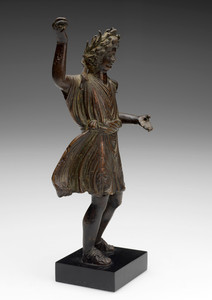


Household God (Lar) Statuette, late 200s CE- early 300s CE
Roman
Bronze
RISD Museum, Anonymous Gift 62.061
In the Roman religious tradition, Lares (singular Lar) were household deities originally involved in agriculture but later associated with familial prosperity. In a ritual spanning the Roman Republican and Imperial periods, Lares statuettes were placed in shrines, or Lararia, prominently located within the home where family members would pray daily and provide offerings on special occasions. Lararia usually included two Lares statuettes flanking another deity. Often crafted from bronze, a typical Lar statuette depicted a young man dressed in a tunic holding a drinking horn (rhyton) or cornucopia in one hand and an offering dish (patera) in the other. This bronze statuette, dating to the Imperial period between the late 200s- early 300s CE, serves as a stereotypical, well-preserved representation of the sculpture type, though it is missing its fingers on its left hand and the object, most likely a rhyton or cornucopia, that would have been held in its right.
Following the “traditional” Lar statuette model, this particular statuette depicts a youthful male figure wearing a billowing, draped tunic belted with a sash. Atop the Lar’s curled hair is a laurel wreath. His expression is neutral, with his right arm stretched above his head and his left outstretched. He is positioned with his right leg slightly in front of his left, which is slightly bent, and he is wearing sandals. Remnants of gilding can be seen in both the underside and folds of the skirt of his tunic, hair, and wreath, and the vertical channels of the skirt suggest that it once included inlaid copper strips.
As evidenced by the hollow cavity found beneath the skirt of the subject’s tunic, this statuette was created using the lost-wax casting technique, a method in which a metal object is cast from a wax mold. While the statuette was seemingly made with care, a casting flaw is apparent at the base of the tunic above the right knee. The small indentations seen on the statuette’s surface are indicative of the corrosive chemical agents used by early conservators.


Comments