Trap Door & Medusa head medallion
- Reflections Exhibit
- Dec 8, 2022
- 3 min read

Updated: Dec 9, 2022
Trap Door, 2022
Astrid McMahon
mixed media installation
I was initially drawn to interrogating the RISD medallion because of its interactions to and similarity with the #medusatattoo movement today. Many people, predominantly women, are now using the iconography of Medusa as a symbol of survival, often from sexual abuse, sexual assault or rape. The parallels with her role as a guardian and protectress within an ancient medallion are striking. These modern echoes stand as a testament to the enduring power of Medusa’s symbology and narrative. And yet they can also be seen to track the achingly slow development of our societies’ perceptions of and responses to acts of sexual violence.
I was also surprised to find Medusa depicted only as a classically beautiful, white woman in the tattoos I saw pictured online. In my piece, I want to interrogate why and how the iconography of Medusa has developed. In the ancient world, she evolved from the ‘grotesque to the beautiful’, a shift for which the RISD medallion acts as one puzzle piece of many, and now seems to have evolved only to conform further to today’s beauty standards. As she steps outside of the victim-blaming inherent within the traditional narratives and mythologies in which she features, how can the image of Medusa also transcend the main-stream, patriarchal, damaging beauty standards that we continue to uphold? This object toys with this question and the empowerment of Medusa’s story and image since the time in which the RISD medallion was made. The mirror asks the viewer to implicate themselves and their gaze. The trap door signals an opportunity for Medusa the woman, so much more than a simple image or symbol, to come center-stage at last.


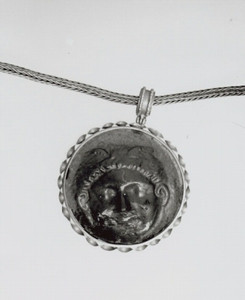
Medusa head medallion, 1st century - 2nd century CE
Roman
Cast glass
RISD Museum, Gift of Mrs. Gustav Radeke 06.037
This circular medallion bears the head of the Gorgon Medusa, a mythical monster cursed with snakes for hair by the goddess Minerva (Athena). She was punished and blamed for the ‘desecration’ of the goddess’s temple after Neptune (Poseidon) sexually assaulted her there. Medusa’s bulging eyes dominate the rendition of her circular face with a direct, frontal stare that seems to challenge the viewer; this deliberate emphasis reinforces her eyes as the primary source of her potency, because her gaze famously turned men into stone.
The motif of Medusa’s head had significant importance in Roman visual culture because she was believed to have apotropaic (protective) powers. Many women considered her a guardian and wore jewelry emblazoned with her features, such as this medallion. It would have most likely been mounted within a setting and been worn as a pendant; the medallion itself was made through the technique of ‘casting’, by pushing molten glass into a hollow, carved mold that is left unsealed as the glass cools. Medusa was widely accepted as a symbol of divine feminine wisdom and was also often linked to ideas of moral conduct and fertility.
Although her symbolism was always, and continues to be, most strongly associated and used for women, medallions identical to this one were also given as military decoration (phalera) to soldiers for distinguished acts of service on the battlefield. The medallions would have been attached in groupings of six or nine to a soldier’s breastplate by a harness of leather straps during parades. This is because both Minerva (Athena) and Jupiter (Zeus) wore depictions of Medusa to deter and scare off their enemies in battle.
It is important to note the idealized features and symmetrical proportions of the depiction of Medusa’s face on this medallion. Beginning in the fifth century B.C., the grotesque iconography of the traditionally demonic Gorgon underwent a visual transformation into the far more anthropomorphic and feminine figure that we associate with Medusa today. Some experts argue that this aestheticization was motivated by a desire to ‘suit the sensibilities’ and beauty standards of the classical period; others, however, believe that this shift belongs to a comic tradition of making heroes (in the case of Medusa’s story, the hero Perseus) the objects of jokes. In this case, Medusa’s beauty can then be seen as a tool to twist and pervert the erotic abduction tales common to Greek mythology.


Comments