Olympian Deities in the RISD Museum
- Reflections Exhibit
- Dec 8, 2022
- 3 min read

Updated: Dec 9, 2022
Goddess of Pleasure, 2022
Giuseppe Presti
Wine (Sangria, Merlot, Zinfandel) on paper
Piece on loan from artist's personal collection 22.002
God of Madness, 2022
Giuseppe Presti
Wine (Sangria, Merlot, Zinfandel) on paper
Piece on loan from artist's personal collection 22.002
God of Thieves, 2022
Giuseppe Presti
Wine (Sangria, Merlot, Zinfandel) on paper
Piece on loan from artist's personal collection 22.002
My counter-narrative piece is centric on the Olympian deities in the RISD exhibit: Dionysus, Aphrodite, and Hermes. Essentially the goal is to portray the aspects of the deities that were not idealized and put into iconography, while also portraying the figures themselves in a manner that is uncommon. All three paintings are in various types of wine which not only plays into the aspect of the wine god, but ties into the theme for the other two as well, such as the pleasures of Aphrodite. Together, rather than as separate pieces, they tell the unseen narrative of our gods on Mt. Olympus.
The titles of the three pieces are: “God of Madness”, “Goddess of Pleasure”, and “God of Thieves.” For Dionysus, I have depicted him neither as a boyish youth (which the RISD museum portrays) nor as a rugged man, but sort of in between. I decided to portray a more stoic look rather than a crazed look as mental illness is not always visible. For Aphrodite, I have portrayed her in the nude, as her statuette is, smoking a cigarette as a representation of the goddess of “pleasures”. As for Hermes, who is normally synonymous with businessmen and messengers, he is portrayed as a thief. In contrast to the armless, headless, leg-replaced statue, Hermes will be wearing a cloak that specifically shows the missing pieces (head, arms, legs) rather than the naked torso.


Aphrodite statuette holding a mirror, 300 - 200 BCE
Smyna (Asia Minor)
Teracotta; gilding
RISD Museum, Gift of Mrs. Gustav Radeke 06.331
This terracotta statuette depicts Aphrodite, the goddess of love, beauty and pleasure, leaning on a pillar and gazing into a mirror, common to her iconography. This statuette is one of the few depictions of female nudity in RISD/s ancient greek and roman exhibit. It seems to mimic a large statue that would need a pillar to support heavy marble or stone. Most likely this statuette was used in a domestic setting as decoration or a cult image for a shrine. Some statuettes were believed to be able to ward off evil; others were used in funerary contexts, such as a gift for a god or a device for protection to aid the deceased into the afterlife.

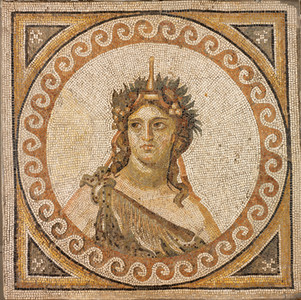

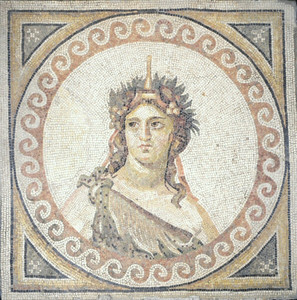
Floor mosaic fragment depicting Bacchus, 325 - 330 CE
Roman, Villa at Daphne near Antioch (modern Antakya, Turkey)
Limestone tesserae
RISD Museum, Museum Collection, by exchange 40.195
While displayed on a museum's wall, this medallion of the wine god Bacchus (the Greek Dionysos) was originally located in the entrance hall of a Roman villa, as part of a much larger floor pavement. The city of Antioch was a vital hub for agriculture and commerce which created a large middle class population due to economic prosperity with a taste for luxurious and beautiful things. Villas in the region were commonly decorated with opulent wall frescoes and floor mosaics such as this one. Bacchus is often displayed in two ways: a rugged bearded man, or a boyish youth. In this instance, the boyish images of the god of wine, insanity, religious ecstasy, festivity, and theater, are meant to create a merry atmosphere of wine-drinking and other pleasures in life.


Male figure in the guise of Hermes, early 100s CE
Roman
Marble
RISD Museum, Gift of Mrs. Gustave Radeke, 03.008
This marble statue is most likely an honorary portrait statue which was common during the Imperial period. Artists would place portrait heads on statues with well-recognized body types associated with specific deities with the intent to embody the virtues associated with the deity. The twist in the mantle draped over the left shoulder has only been found on representations of Hermes (Mercury in Rome). Hermes was the patron of many things, such as messengers, travelers, speed, thieves, and trade businessmen, and the particular body type in this statue was commonly found in businessmen, suggesting that the male figure in the guise of Hermes too was a businessman.
These three pieces are among the few artistic representations of Olympian deities within the RISD exhibit. All of them display the ideal form of their respective deities: the goddess of beauty Aphrodite, the god of businessmen Hermes, and the god of festivity Bacchus. However the representation of what mankind does not want to see in their deities are rarely found. Aphrodite is also the goddess of pleasures; Hermes the god of thieves; Bacchus the god of madness. Despite this, there are very few artistic representations of these gods displaying such qualities. After all, deities are portrayed to display their virtues, not their vices.


Comments