A Gilded Cage of Sexism & Bust of Agrippina the Younger
- Reflections Exhibit
- Dec 8, 2022
- 4 min read

Updated: Dec 9, 2022
A Gilded Cage of Sexism: The (Miss)representation of Agrippa the Younger, 2022
Morgan Valentine
Acrylic paint, ink, and photography on canvas
As I walked around exploring the RISD museum’s galleries of classical art I was drawn to a statue of an imposing woman whose blank eyes pierced me to my soul. When I turned to learn more about her from her description I was met with the subject’s name, Agrippina the Younger, and a list of four emperors to whom she was related to in some capacity to explain why her statue has survived the test of time. Annoyed to find that my new muse was only defined by her relation to influential men, I decided to pursue my own research to understand who this woman was. It took no more than a simple google search to learn that Agrippina not only was born into a powerful family but also an infamous villain known for her sexual and murderous proclivities. As I dove deeper into the research on Agrippina, I discovered that most of what we know about her derives from accounts written by men such as Cornelius Tacitus and Cassius Dio who were both born after Agrippina’s death and therefore only were able to capture her post-mortem reputation. Additionally, Imperial Rome was a deeply patriarchal society barring women from taking political office on the belief that women’s control should only remain in the running of a household. Therefore, women who exercised influence outside of the realm of the home are consistently cast as villains in written sources.
Agrippina is described as seducing her uncle Claudius to supplant his son Britannus with her son as the heir to the empire. What the authors don’t acknowledge is that unlike Claudius, Agrippina was a direct descendent of the Augustan bloodline, therefore her marriage to Claudius strengthened his own claim to the empire and unlike Britannus, Nero also possessed a stronger blood connection to the first emperor. This added context illuminates the flaws in taking these written sources as absolute truth. The author’s operated from a particular agenda and chose to focus on a specific narrative to enact it. The truth is that we know very few absolute truths about Agrippina. We know that we she was a literate woman because scraps of her autobiography have survived, that she colonized the town of her birth and named it after herself and that her visage graces coinage used all over the roman empire. She may have been a scheming murderess responsible for destroying women and poisoning her own husband, but her 60-year-old husband may have simply perished from old age.
To capture these dynamics of the history of Agrippina, I decided to execute an artwork which shows the gilded cage created by these ancient sources. Written documents tend to be prioritized in the field of archeology over psychical findings, so I wanted to show how these written sources have imprisoned the true Agrippina from our view. I invite viewers to stare into Agrippina’s eyes and wonder who this woman truly was.

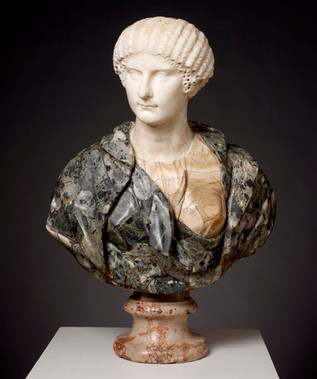


Bust of Agrippina the Younger, ca. 40 CE
Roman
Head in Parian marble. Bust is an 18th-century addition in colored marble
RISD Museum, Anonymous Gift 56.097
Born in approximate 15 CE to one of the most powerful Roman families and as one of the few
descendants of former Emperor Augustus, Agrippina the Younger came into this world ready to become the most powerful woman in the Roman Empire. Her family prioritized education and Agrippina’s intellectual prowess is evident through the remaining scraps of her autobiography. Ancient Roman texts, written after her death, portray Agrippina as a power-hungry, incestuous murderer known for seducing her uncle Emperor Claudius and convincing him to replace his own heir with her son, the future emperor Nero, before poisoning Claudius with toxic mushrooms. Authors such as Tacitus and Dios condemn Agrippina for reigning over the trial of Briton from her own platform equal to Claudius’s and for overall taking the Augusta status to a new level of power. Given the patriarchal values of imperial Rome, it is undeniable that for Agrippina to have reached such a position of power and prestige she must have been an active driver of her rise. However, it is impossible to know if she committed all the actions for which she has been vilified for. Especially as modern historians analyzing these texts have identified the trend of defaming any woman who stepped into a role of power reserved for men. Additionally, it is equally possible that Claudius sought out their marriage as it improved his claim to the title emperor because he lacked the blood connection to Augustus which she possessed. Agrippina may have very well been the manipulative villain described in these texts, but she may have been a privileged and well-educated woman trying to make the empire a better place with the prestige she had been afforded. It is up to us viewers to critically consider this history and imagine who this woman could have been.
This bust, the head of which was created during the reign of Agrippina’s brother emperor Caligula, undoubtable depicts Agrippina as her visage matches her profiles placed on coinage created during Claudius’s reign. The bust was created after Caligula had exiled Agrippina out of Rome with her three-year old son and in the same year as the death of Agrippina’s husband Domitius. Therefore, it portrays a young Agrippina at the beginning of her political career. Perhaps it was commissioned after her husband’s death to help her secure a new husband or a gift from one of the many men said to be her lover at this time. It is important to acknowledge that the colorful marble supporting Agrippina’s head was later added in the 18th century as was the fashion at the time. Although it does not represent how this bust would have been originally displayed, it infuses this artwork with some of the colorful tones which would have been used to paint Agrippina’s features on the white marble.


Comments